





M.Sc. Mathematics is a serious commitment — two years, a challenging curriculum, and a very competitive admission process. But for students who are genuinely passionate about Mathematics, it opens doors that almost no other postgraduate degree can.
This is what you need to know — about the degree, the admission process, the career options, and how to prepare well.
What Is M.Sc. Mathematics, Really?
M.Sc. Mathematics is a 2-year postgraduate course for B.Sc. graduates in Mathematics or related fields. Admission requires 50–60% marks or qualifying entrance exams like CUET PG, IIT JAM, BHU PET, JNUEE, or DUET.
The syllabus in M.Sc. goes significantly deeper than B.Sc. — and across more advanced topics. While B.Sc. gives you the tools, M.Sc. teaches you how to use them with precision, rigour, and depth.
Typical M.Sc. Mathematics subjects across major Indian universities include:
• Topology (advanced) — covering compactness, connectedness, quotient spaces, and more
• Measure Theory and Lebesgue Integration — the rigorous foundation of modern analysis
• Functional Analysis — Banach and Hilbert spaces, bounded linear operators
• Complex Analysis — analytic functions, conformal mappings, Riemann surfaces
• Abstract Algebra — Galois theory, modules, advanced ring theory
• Partial Differential Equations — with applications in physics and engineering
• Numerical Analysis — computational methods and approximation theory
• Differential Geometry (in many programmes)
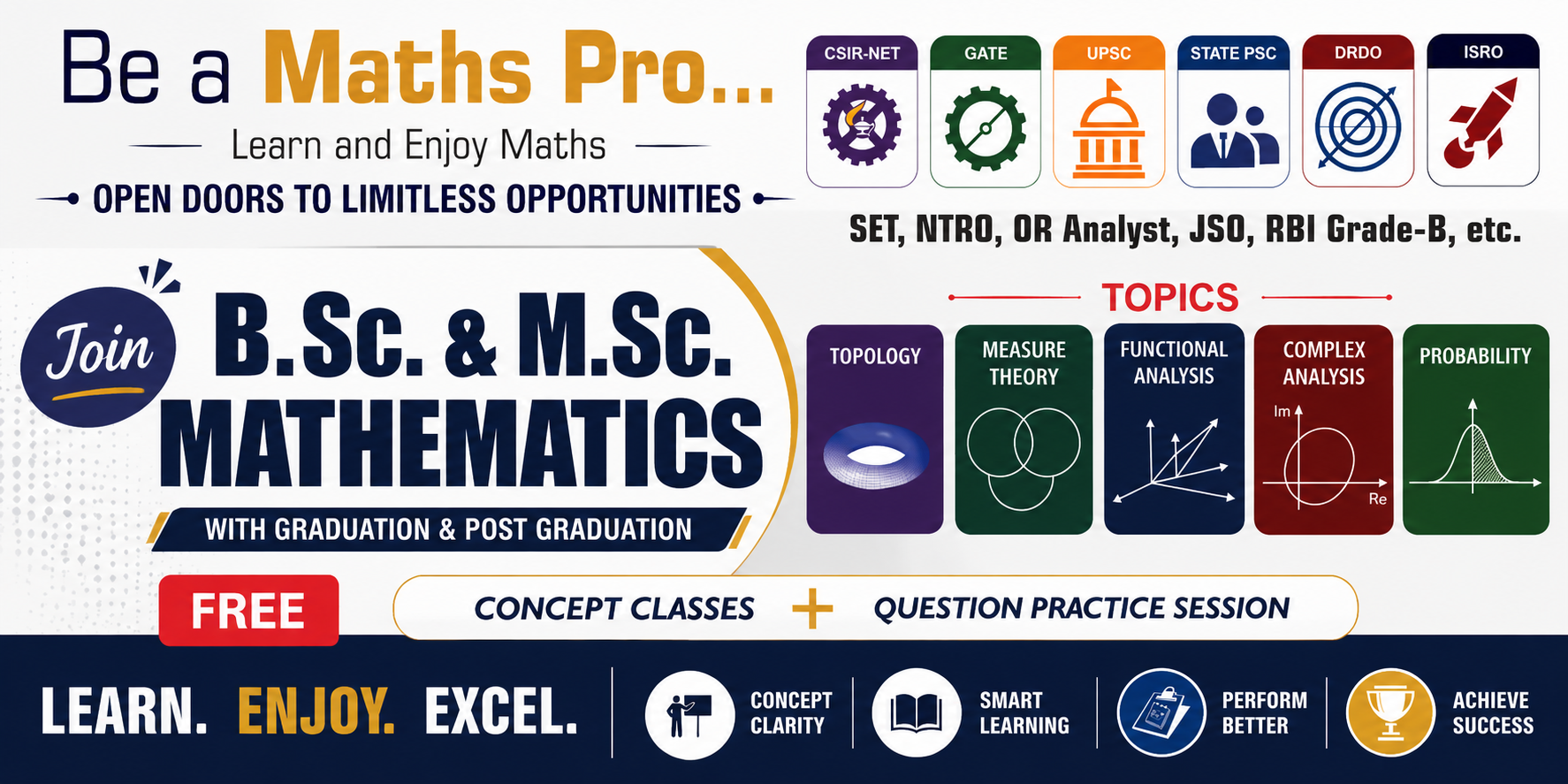
The subjects covered in DIPS Academy's coaching — Topology, Measure Theory, Functional Analysis, and Complex Analysis — are the four pillars that M.Sc. students across universities consistently find most challenging. And they're also the four subjects that appear repeatedly in national competitive exams like CSIR NET, GATE, and IIT JAM.
How Do You Get Into a Good M.Sc. Programme?
The admission route depends on where you want to study.
IITs and IISc — IIT JAM IIT JAM (Joint Admission Test for M.Sc.) is the premier entrance exam for M.Sc. Mathematics admissions at IITs, NITs, and IISc Bangalore. It's highly competitive — over 1.5 lakh students register every year, with a few thousand seats across the participating institutes.
Central Universities — CUET PG: CUET PG (Common University Entrance Test for Postgraduates) is the gateway to M.Sc. Mathematics at Delhi University, JNU, BHU, AMU, University of Hyderabad, and other central universities. Each university has its own cutoffs and selection criteria.
University-Specific Exams: BHU PET, JNUEE, DUET — many individual universities also conduct their own entrance exams with specific syllabi.
State Universities: Many state universities admit students based on B.Sc. marks alone, or through state-level entrance tests.
The syllabus for most of these exams — IIT JAM in particular — overlaps significantly with B.Sc. and M.Sc. Mathematics content. Students who have a strong grip on Topology, Analysis, Algebra, and Functional Analysis are in a far better position.
The Career Picture After M.Sc. Mathematics
M.Sc. Mathematics significantly expands your options compared to B.Sc. alone. Here's what the data looks like:
M.Sc. Mathematics graduates are recruited by organisations such as ISRO, DRDO, CSIR, Goldman Sachs, J.P. Morgan, TCS, Infosys, Amazon, Fractal Analytics, and Mu Sigma — across research, analytics, finance, technology, and consulting.</cite>
Freshers typically earn ?3–6 LPA in roles like data analyst, while experienced professionals in data science, actuarial science, or quantitative analysis can earn ?12–20 LPA or more.</cite>
Graduates from top institutes such as IITs or ISI may secure packages exceeding ?15 LPA, with strong growth prospects in high-demand fields.</cite>
Let's break down the specific career paths:
1. Data Science and Machine Learning This is where the highest volume of private sector hiring happens for M.Sc. Maths graduates. If you enjoy working with numbers and logic, MSc Maths is your entry ticket to high-paying roles in data science, machine learning, and business analytics.</cite> Adding Python, SQL, and machine learning skills to your M.Sc. degree makes you highly competitive.
2. Research — CSIR NET / JRF CSIR NET (National Eligibility Test for Junior Research Fellowship) is the primary gateway to funded research in Mathematics in India. Qualifying as JRF gets you a monthly stipend (currently ?31,000–?35,000), while Lectureship qualification opens the door to assistant professor roles at universities and colleges.
3. Higher Studies — Ph.D. Many M.Sc. students go on to Ph.D. at IITs, IISERs, TIFR, BARC, HRI, CMI, or universities abroad. A strong CSIR NET/JRF score significantly improves your chances of admission to top Ph.D. programmes.
4. Assistant Professor After earning your M.Sc. from an IIT or completing CSIR NET, you can apply for direct recruitment to Indian universities as a Lecturer or Assistant Professor.</cite> State Public Service Commissions (UPPSC, RPSC, HPSC, MPPSC) also recruit Assistant Professors in Mathematics — DIPS Academy specifically offers coaching for these exams.
5. Government Sector — ISRO, DRDO, Railways There are several positions available in Indian Railways for M.Sc. graduates. Other government agencies, including ministries and banks, also hire M.Sc.-qualified candidates.</cite> Research organisations like ISRO and DRDO regularly recruit for scientific positions that require advanced mathematics.
6. Finance and Actuarial Science Quantitative analysts, risk analysts, and actuaries with M.Sc. Mathematics backgrounds are in steady demand at financial services firms. JPMorgan, Goldman Sachs, and insurance companies are consistent recruiters.
The Subjects Most M.Sc. Students Find Hardest — and Why
Let's be direct about this. M.Sc. Mathematics is not easy. The four subjects that consistently challenge even capable students are:
Topology: The jump from metric spaces to general topological spaces is conceptually difficult. Open and closed sets, compactness, connectedness, and continuity in abstract spaces require building a completely new kind of geometric intuition. Most students have seen some of this in B.Sc. — but M.Sc. Topology goes much further.
Measure Theory: Understanding sigma algebras, measurable functions, and Lebesgue integration (as opposed to Riemann integration) is one of the biggest conceptual leaps in the M.Sc. curriculum. It's abstract, it's precise, and it underpins a huge portion of advanced mathematics and statistics.
Functional Analysis: Normed spaces, Banach spaces, Hilbert spaces, and bounded linear operators — Functional Analysis is essentially the study of infinite-dimensional spaces. It requires solid Analysis and Linear Algebra foundations and a willingness to think in very abstract terms.
Complex Analysis: Analytic functions, Cauchy's theorem, the Residue theorem, Laurent series — Complex Analysis is beautiful and powerful, but the level of rigour in M.Sc. is significantly beyond what most students encountered at B.Sc.
All four of these also appear prominently in CSIR NET, GATE Mathematics, and IIT JAM — which means getting them right during M.Sc. is an investment that pays off directly in competitive exam performance.
How DIPS Academy Supports M.Sc. Students
DIPS Academy has been at the centre of Mathematics education in India for over 30 years. With 40,000+ students mentored, the academy has seen exactly where M.Sc. students struggle — and built its teaching methodology around solving those specific problems.
The B.Sc. / M.Sc. Mathematics Coaching at DIPS Academy is led by Rajendra Dubey Sir, a widely respected Mathematics educator whose concept-driven approach has helped thousands of students not just pass their exams, but genuinely understand the subject.
What the programme includes:
• Live interactive online classes — attend from anywhere in India. No need to relocate to Delhi.
• Recorded lectures — so you can revisit any concept at your own pace
• Dedicated doubt-solving sessions — your questions get answered, not skipped
• Practice with university-level questions — so exam day has no surprises
• Preparation that doubles as CSIR NET / GATE / IIT JAM readiness — because the syllabi overlap significantly
Subjects covered: Topology | Measure Theory | Functional Analysis | Complex Analysis
Pricing:
• Single subject: 700
• Complete Combo (all 4 subjects): 2,000 — that's ?500 per subject, saving ?800
The next batch starts 22nd August 2026.
A Word on Competitive Exams After M.Sc.
If you're doing M.Sc. Mathematics, you should be thinking about CSIR NET from Day 1 — not as an afterthought in your final semester.
Here's why: the CSIR NET Mathematics syllabus and the M.Sc. Mathematics syllabus are almost the same thing. Topology, Analysis, Algebra, Functional Analysis, Complex Analysis — these are core to both. Students who treat their M.Sc. coursework seriously and supplement it with regular practice are the ones who clear CSIR NET in their first or second attempt.
DIPS Academy's coaching for these M.Sc. subjects is specifically designed with this dual purpose in mind — helping you excel in university exams while simultaneously building the foundation for CSIR NET, IIT JAM, and GATE.
FAQ
Q: What's the eligibility for M.Sc. Mathematics in India? Candidates should have a B.Sc. degree (preferably in Mathematics or an allied subject) from a recognised university with at least 50–55% aggregate marks. Admission is based on entrance exams like IIT JAM, CUET PG, or university-specific tests.</cite>
Q: Which entrance exam should I target for M.Sc. Maths? IIT JAM is the most prestigious — it gives you access to IITs, NITs, and IISc. CUET PG covers central universities like DU, JNU, and BHU. If you're targeting a specific university (Hyderabad, JNU, BHU), check their individual admission process as well. DIPS Academy prepares students for IIT JAM, CUET PG, and university exams.
Q: How much can I earn after M.Sc. Mathematics? It varies by path. The Mathematics salary at entry level ranges between 2.5–5 LPA, for mid-level profiles 5–10 LPA, and for senior-level profiles 12–25 LPA. In data science or finance with additional skills, packages go higher, especially from top institutes.
Q: Can I join DIPS Academy's coaching from outside Delhi? Yes — all classes are fully online and live. Students from universities across India attend. You join from wherever you are.
Q: Can I enroll for just one subject? Yes. Single subject enrollment is available at 700. The full 4-subject combo is 2,000.
Q: Does DIPS Academy's coaching help with CSIR NET as well? Absolutely. The subjects in this coaching — Topology, Measure Theory, Functional Analysis, Complex Analysis — are core CSIR NET topics. Many DIPS Academy students use this coaching to simultaneously prepare for university exams and CSIR NET.
Q: When does the next batch start? 22nd August 2026. Enroll at dipsacademy.com or call +91-9990826655.
Q: Is the coaching useful even if I'm already in the middle of my M.Sc.? Yes. Many students join mid-programme when they hit a wall in a specific subject. Whether you're just starting M.Sc. or preparing for end-semester exams, the structured coaching and doubt sessions are valuable at any stage.


